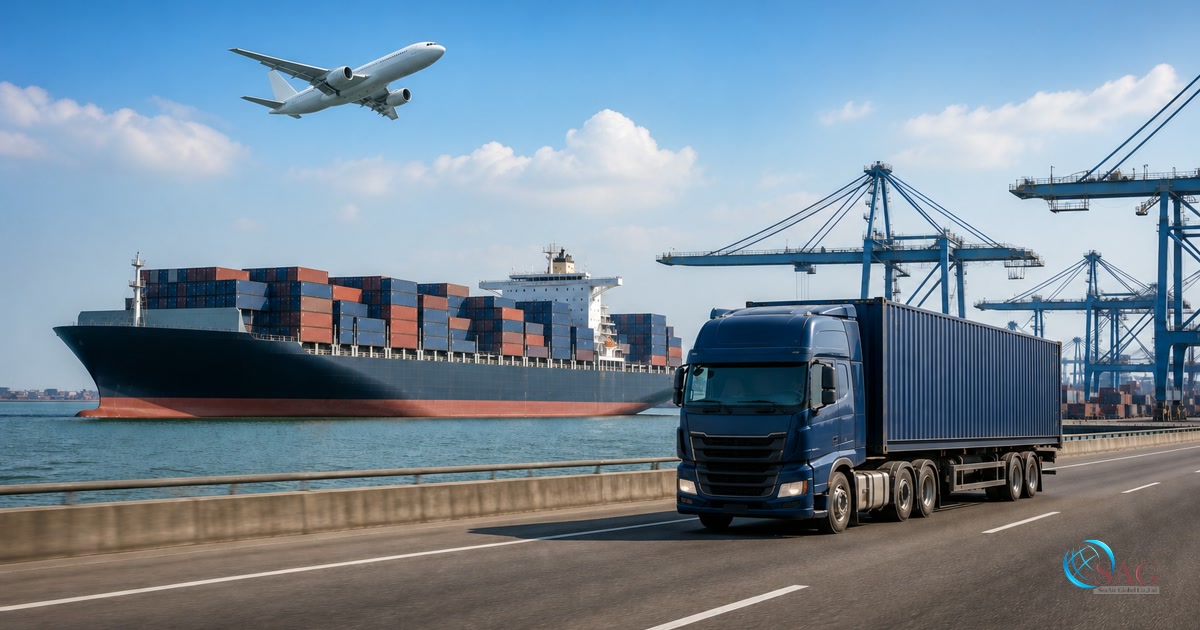
The same shipment from China to Vietnam may move by sea, road or air. The right mode depends on more than the lowest headline rate: it depends on the delivery deadline, pickup and delivery points, chargeable weight, cargo requirements and total service scope.
Quick comparison
| Mode | Often suitable when | Check carefully |
|---|---|---|
| Sea | Heavy, bulky or large-volume cargo with planning flexibility | Sailing, ports, LCL/FCL, THC, cut-offs and rollover risk |
| Road | Pickup is in South China and flexible inland delivery is valuable | Border capacity, transloading, customs hours, permits and delivery scope |
| Air | Urgent, high-value, component or sample cargo where time matters | Chargeable weight, dimensions, batteries/dangerous goods, flight and airport charges |
There is no fixed ranking. A light but bulky shipment may be charged by volumetric weight in air freight. A low ocean base rate may exclude substantial origin and destination costs. Road freight may be fast on a suitable corridor but sensitive to border conditions.
1. Choose sea freight for capacity and larger cargo
Sea freight commonly suits heavy cargo, multiple pallets, machinery, raw materials and shipments large enough for FCL. LCL avoids paying for a full container, but adds consolidation, deconsolidation and CFS handling.
Confirm the following before choosing:
- The origin port nearest the factory and the destination port that fits final delivery.
- FCL or LCL, equipment type and loading requirements.
- Direct or transshipment service.
- SI, VGM, customs and gate-in cut-offs.
- Whether base freight includes THC, documentation, inland transport and destination charges.
Sea freight works best when the business can plan ahead and allow for schedule variability. Do not apply one fixed transit time to every port or week.
2. Choose road freight when the border corridor fits the pickup and delivery
Road can be useful for cargo from Guangxi, Guangdong and nearby areas into northern Vietnam or onward through Vietnam's domestic network. Its main advantage is flexible pickup and delivery without waiting for a weekly vessel schedule.
The quotation should state:
- The formal trade route and border crossing used.
- Whether cargo is transloaded or the tractor/truck changes at the border.
- Who handles export and import declarations and supporting documents.
- Whether the price is door delivery or only to a yard/border point.
- How truck waiting, storage and inspection charges apply.
For cargo requiring quarantine, specialist inspection or permits, faster physical movement does not always mean faster end-to-end clearance.
3. Choose air when the value of time exceeds the rate difference
Air freight commonly suits urgent replacement parts, samples, high-value cargo or small shipments with a firm deadline. Include the cost of delay in the comparison: production stoppage, missed sales windows, contract penalties or lost opportunity.
An air-freight quotation needs at least:
- Origin/destination airports or pickup/delivery addresses.
- Piece count, dimensions per piece and actual weight.
- Commodity, indicative HS code and intended use.
- Batteries, magnets, liquids, chemicals or temperature-control requirements.
- Delivery deadline and airport-to-airport or door-to-door scope.
IATA promotes e-freight and the e-AWB to digitise air-cargo documents, but shippers still need accurate cargo data and shipment-specific customs documents.
4. Compare total logistics cost, not only main freight
Ask each option to cover the same scope:
- Factory/supplier pickup.
- China export clearance.
- Main freight and surcharges.
- Port, airport, border or transfer-warehouse charges.
- Vietnam import clearance.
- Final delivery and waiting/unloading terms.
Incoterms allocate cost and risk between buyer and seller, but they do not replace a detailed transport quotation. State the named place with EXW, FCA, FOB, CIF, DAP or DDP.
Five inputs to confirm before requesting rates
- Full pickup and delivery addresses.
- The real delivery deadline, not only the desired departure date.
- Pieces, dimensions, weight and packing method.
- Commodity, indicative HS code, batteries/dangerous goods and regulatory needs.
- Incoterm and the service scope to be quoted.
With these inputs, a forwarder can compare modes on the same basis and recommend a primary and backup option.
Sources
Send your shipment details for a SeaAir Global comparison of sea, road and air options based on the actual pickup, delivery and deadline.